Why might that matter? For one thing, it could possibly affect the duration of the copyright term. The works are described as “the products of a commission by Commodore International,” but it seems unlikely that they are considered a work-for-hire. If that were the case, copyright would last for 95 years from first publication—in this case 2109. If the earlier date were put in the notice, copyright could be found to expire that much earlier, as soon as 2080.
But if it were a work for hire, it’d be Commodore, and not Warhol(‘s Foundation) that held the copyright. That’s not the case. Instead, it’s just a standard unpublished work, so copyright lasts for Warhol’s life plus 70 years: until just 2057.
Anyway, for the most part this is an exciting find for art history. But there are a few things I find really sad. For one, the fact that his works will be locked up until 2057 is terrible. His fondness for appropriation just lends a grim irony. Of course, by understanding what the copyright notice date meant I got the work into the public domain almost 50 years earlier, but that ambiguity can still cast a shadow of uncertainty over the use for decades.
Also, of course, a “stronger” copyright system could have prevented Arcangel from ever seeing the Warhol video that led to this discovery. “Strong” copyright encourages rightsholders to publish works only in ways that will provide known value; discoveries like Arcangel’s are the kind of surprise value that a more lax system allows.
It’s sad, too, that the hurdles these retrocomputing experts faced are exacerbated by DRM and anti-circumvention laws. And without the cooperation of the Warhol foundation, this restoration work could have been deemed impossible. Advocates for stricter copyright like to wave the flag of the artists. But surely the fact that so much art history is at risk hurts those artists, too.
I attended the ABC v. Aereo oral arguments in the Supreme Court Tuesday and had a great time overall. Lots of people have written about the case and the arguments—Ali Sternburg, my line-standing buddy, has eight takeaways that are excellent—but one largely unmentioned line from the broadcasters’ lawyer really drove me up the wall. In the very last few minutes of the case, the attorney Paul Clement said this about Aereo:
if they actually provide something that is a net benefit technologically, there’s no reason people won’t license them content. But on the other hand, if all they have is a gimmick, then they probably will go out of business and nobody should cry a tear over that.
That idea, that the best technological solutions will have no problem locating all the necessary rightsholders and negotiating feasible deals is just ridiculous. It’s either totally naive or intentionally disingenuous. Fortunately, Justice Breyer (who is one on the Court who really understands copyright issues) called him out:
Once you take them out of the compulsory licensing system, they’re going to have to find copyright owners, who owns James Agee’s pictures? Who owns something that was written by like a French silent film in 1915? I mean, the problem is that they might want to have perfectly good things that people want to watch and they can’t find out how to get permission. That is a problem that worries me and it worries me again once you kick them out of the other systems.
Breyer is spot on, and he’s even being generous. Excessive copyright terms have exacerbated an orphan works problem that makes any use of anything produced in the last 100 years or so an exercise in uncertainty. But beyond that, there’s never ever been an example of a permissions culture that functioned like a free one. This is exactly the point I was getting at when I compared Netflix’s first-sale based DVD selection with its much, much weaker permission-culture streaming library.
Anyway, it’s good to see a justice call out that kind of blatant falsehood spouted in the Court. I hope Breyer is able to convince his colleagues about the big issues at stake with these tiny antennas.
I wrote a piece for Techdirt about how a shift from the “permisionless”—but paid—DVD rental business to the permissions intensive movie streaming has prevented Netflix Instant from having anything like the selection of old-fashioned Netflix.
It should be astonishing that a company that once had to maintain and transport a staggering inventory of fragile plastic discs is able to offer less when its marginal cost dropped to near zero.
The problem is that, unlike earlier movie-rental options, streaming rights fall fundamentally within a permission culture. Netflix is a great illustration of what’s gone wrong here. It’s gone from having a nearly unrivaled catalog of films available to rent to being the butt of Onion jokes. What happened: It shifted from a system where nobody had a veto power over its operations, to one where it had to get permission and make deals with Hollywood. Sometimes it’s difficult to find the concrete costs of living in a permission culture, but the decline of Netflix’s selection is an important cautionary tale.
I’d been meaning to write this for a long time! I like the way it came together, and I’m glad I got a chance to lay this line of reasoning out.
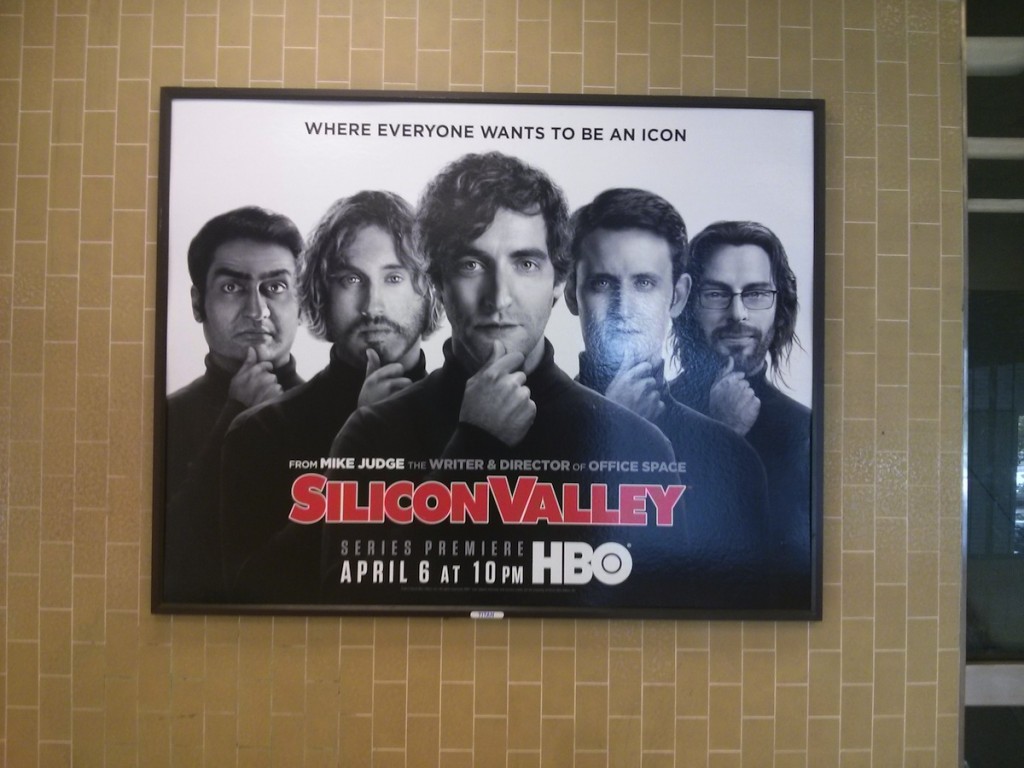
In case you’re not familiar with the original, this is a straightforward parody of Albert M. Watson’s famous portrait of Steve Jobs, which appeared on the cover of Jobs’s biography and the memorial Apple homepage after his death.
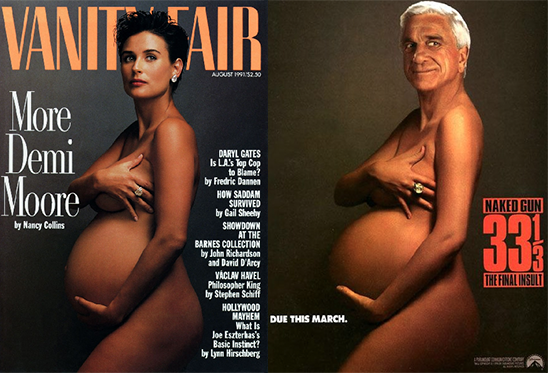
Maybe I had copyright on the brain more than usual, but the ad immediately brought to mind the case Leibovitz v. Paramount. That case was over whether an advertisement for a Naked Gun movie (below, right)—a parody of an Annie Leibovitz portrait of Demi Moore on the cover of Vanity Fair (below, left)—was a fair use. ((Side note: I don’t remember this magazine cover or movie ad firsthand, but what staying power must the photo have had to be the recognizable target of a parody two years later! Is there any magazine cover in the past decade that is so iconic?))
The Second Circuit ruled that yes, the use was fair. The case has become quite influential; along with Campbell v. Acuff-Rose in 1994, it’s one of the clearest citations for the fact that commercial use does not preclude a finding of fair use.
So back to Silicon Valley. The parallels between the two cases should be clear: an advertisement as a parody of an iconic photograph, recreated by a new photographer, but with a more-than-substantial similarity to the original. In fact, not much distinguishes the two cases. I’d expect a copyright claim from Watson to fail, especially if brought in the Second Circuit.
Interestingly, Watson has litigated over the photograph. Almost exactly a year ago, he brought a suit against artist Alex Guofeng Cao and a partner David Datuna for creating “high art” derivative works of the photograph. One, “Steve Jobs vs Neil Armstrong, After Watson,” was part of a gallery show; the other, “Steve Jobs-Ayn Rand,” sold to a collector for over $200,000.
A work’s status as fine art seems sometimes (but not always!) to weigh in favor of a finding of fair use. The Second Circuit ruled mostly in favor of appropriation artist Richard Prince in a major fair use case last year, for example—a ruling that came down just days before Watson filed suit. We won’t know how that factor would have affected the decision in this case, though, because the parties apparently settled last month—March 6.
It’s possible, too, that Silicon Valley has a license with Watson. It’s a hard thing to find out because there doesn’t have to be any public record of the license. That’s one reason why policing copyright on user-generated platforms is much more complex than some copyright maximalists like to make out: it can be impossible to distinguish a lawfully licensed work from an infringing one, and even more complex if fair use is a factor.
Even if the use of the photograph is a definite fair use or licensed, there’s another interesting possible legal obstacle. (I’m not a lawyer, and we’re out on the fringes here, so take this with a grain of salt.) It seems possible that the estate of Steve Jobs could claim the ad infringes his right of publicity. Such a claim in the Ninth Circuit could lean on White v. Samsung, where a majority held that a robot shown in a Samsung ad was too similar to Vanna White. Judge Kozinski’s dissent in this case is an all-time great.
But doesn’t the group of Silicon Valley guys wearing the famous Jobs turtleneck and in his thoughtful pose evoke Jobs’s image just as much as the Samsung robot evokes White’s? In any case, I agree much more with Kozinski’s dissent than the holding in the case. I hope we don’t see such a challenge.
For the third year in a row (see 2012, 2013) I’ve put together the April Fools’ Day edition of EFF’s EFFector newsletter. I feel like the tide has really turned against online April Fools’ jokes, but to my mind this is something different. There’s no trying to trick people, no ha-ha-this-is-the-opposite-of-what-we-normally-do, no lame fake acquisition, just jokes. What’s wrong with jokes?