For the first time in a long time I have started a new article on the Wikipedia. This one’s about Michael S. Rogers, Navy Vice Admiral and presumptive nominee for Director of the NSA and head of the U.S. Cyber Command. These two jobs are the one being vacated by General Keith Alexander after he retires in mid-March, and obviously it’ll be kind of a crazy time to be taking over the NSA.
I thought a long time ago that it would be harder and harder to create new Wikipedia articles as most everything is covered by the million-plus pages on the site. But of course, the list of notable things will never stop growing right alongside.
It seemed especially important that Michael S. Rogers have a page now, because he’s likely to be in the news a lot more if he actually does get the nomination, and it’s perilously easy to confuse him with Michigan Representative Mike Rogers, Chairman of the Permanent Select Committee on Intelligence. ((And there’s actually a second Representative Mike Rogers in the House from Alabama.)) These two men have a lot of overlap in their jobs, it’ll be interesting to see how the national security community decides to disambiguate them.
It’s also nice that there’s a public domain photograph of the guy from his Navy bio. That made the page come together and look like a real encyclopedia article quickly. I’d forgotten the feeling I get when I first make an article—I keep hoping somebody else will come along and edit and add and flesh the thing out. I guess that will happen pretty quickly if he gets nominated and confirmed.
One of the excellent things about running Copyright Week—and there were many—is that copyright activists around the world gave some top-level overviews about what is going on in their countries. Two of my favorite came from regions where copyright reform has been long promised but yet to materialize: Australia and Brazil.
The Australian Law Reform Commission (ALRC) has now delivered its final report on Copyright to the government. Current copyright exceptions have not kept pace with the digital world, and don’t adequately protect important internet-related activities such as caching or cloud computing. From a consumer perspective, sharing photos (when you don’t own the copyright) on sites such as Facebook and Tumblr is off-limits – unless you have permission from the rights-holder. Or, in a professional context, you can watch a video on YouTube, but you can’t include it in a presentation to colleagues at work, or for a conference. (Check out other examples of how Australia’s current copyright law is out of touch at the Australian Digital Alliance’s #copywrong site.)
The Attorney-General announced in December that the ALRC recommended “the introduction of a flexible fair-use exception as a defence to copyright infringement”, similar to that in place in the US.
…what is most troubling about the future ahead is that the entire copyright reform process could lose considerable momentum in 2014. A lot was already lost during 2013, considering civil society has turned its focus to Marco Civil. On top of that, the Snowden leaks and the upcoming Global Multistakeholder Meeting on the Future of Internet Governance, to be held in São Paulo, have turned copyright into a secondary concern. Privacy and surveillance seem to have taken the front stage.
It’s great to follow copyright around the world, especially as deals like the Trans-Pacific Partnership threaten to export laws from all different countries. So it’s nice to have people in these countries laying out what’s happening on the ground there.
I’m having an issue on Android where every time I type the letters D-O-N-T it corrects to “DONT” (and not “don’t”). I can’t figure out to fix that, but in my attempts I came across my personal dictionary of words I’ve added to the spellcheck. I think this list is pretty hilarious. Here it is, in its entirety:
Today’s my birthday. And although I believe that the traditional “Happy Birthday” song is in the public domain but for copyfraud of enormous proportion, it’d still be nice to partake in a new musical tradition. The Free Music Archive held a contest this year to write a new birthday tune. They picked some pretty great winners!
If singing isn’t your jam, I recommend today only the Open Goldberg free culture recording of Bach’s Goldberg Variation 26. The whole collection is great, but 26 for my birthday.
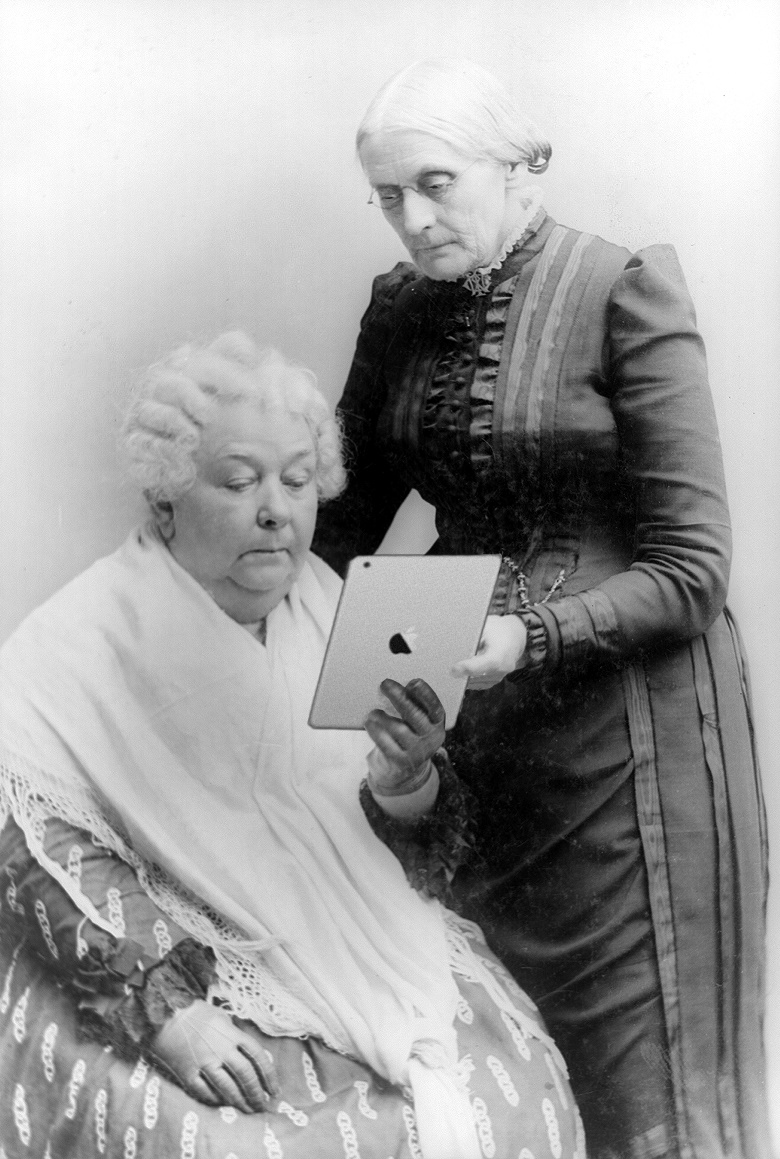
I made this goofy picture for something on Twitter, but I want to make sure I save this one for posterity. Anyway, here’s Susan B. Anthony teaching elder stateswoman Elizabeth Cady Stanton how to use her new iPad.