Earlier this week I was treated to a visit from some two dozen of San Francisco’s wild parrots, the cherry-headed conures that live on and around Telegraph Hill. It was pretty spectacular — I was sitting at the kitchen table by the window, and first one, then two, then maybe a half dozen landed right outside on my balcony, occasionally conferring with a larger group that had set down on the roof.
I had heard of these birds, but had never seen them for more than a few seconds as a flash of green coming out of a tree. I took all these pictures from the table with my phone, not wanting to get up and startle them, but they stuck around for some 20 minutes.
I hadn’t seen the documentary about them, though I had long been meaning to. I made a point to watch it last night, and enjoyed it, and it is definitely weird.
I also feel, and I can’t tell if this is just confirmation bias, like maybe people are pretty much over April Fools’ Day jokes online. I had fun putting together this newsletter, but it seems like each year there are fewer jokes on other sites that I actually enjoy.
(ThinkGeek is usually an exception. Let’s see what they’ve got this year.)
It’s really great to read today’s Supreme Court decision in Kirtsaeng, in which a bad opinion could have had very profound and negative consequences way beyond the normal contours of copyright. I attended the oral arguments in October (during Hurricane Sandy!) and wrote it up for EFF. I’ve been eagerly awaiting the decision since then, and I’m not disappointed. Here’s one of my favorite paragraphs from the decision:
Finally, the fact that harm has proved limited so far may simply reflect the reluctance of copyright holders so far to assert geographically based resale rights. They may decide differently if the law is clarified in their favor. Regardless, a copyright law that can work in practice only if unenforced is not a sound copyright law. It is a law that would create uncertainty, would bring about selective enforcement, and, if widely unenforced, would breed disrespect for copyright law itself.
Good news. Somebody in the office here called it “the first good Supreme Court decision on copyright in two decades.” I’ll take it.
Like many around the web, I was struck last month by the obituary of Bell Labs engineer John E. Karlin, whose greatest legacy may be the keypad design on traditional touch-tone phones. (That is, the arrangement in a 3×3 grid with the 1-2-3 across the top instead of the bottom.) I had long heard the urban legend explanation that the arrangement was deliberately designed to slow down a population trained to quickly enter strings of numbers on calculators and cash registers and prevent them from overwhelming the phone system. It’s nice to hear that not only was there deliberate thought behind it, but real behavioral research.
(There are similar legends, too, about the QWERTY keyboard being developed to intentionally slow down typists to avoid jamming the keys. This is at least controversial and probably wrong.)
His story also reminded me of the creation of another well-known keypad arrangement: the arrow keys on computer keyboards. To me the familiar inverted-T seems like the only plausible arrangement, but there were actually a handful of different options in production for a while. Jim “Brons” Burrows was an engineer at DEC which developed the inverted-T keypad that later became the industry standard, and his first-person account of that development process is a really interesting read.
Of course, the CBP drones weren’t the only option. The day after Lorenzo’s story, Ryan Gallagher at Slate got in touch with the FAA, who said that “no agency has asked us to issue a certificate of authorization for operating UAS as part of this search.” That pretty much rules out the option that the LAPD was flying drones, even if they were officially refusing to confirm or deny the story.
Given that Dorner was discovered in close proximity to a police outpost, it seems unlikely that a drone covering more territory would have been much help. But now we know, more or less, that it wasn’t used in this case.
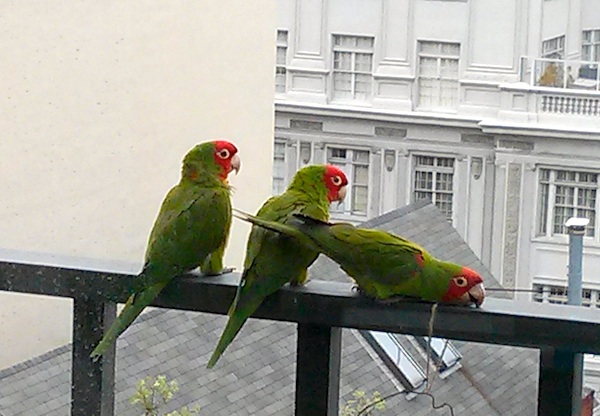 Earlier this week I was treated to a visit from some two dozen of San Francisco’s wild parrots, the cherry-headed conures that live on and around Telegraph Hill. It was pretty spectacular — I was sitting at the kitchen table by the window, and first one, then two, then maybe a half dozen landed right outside on my balcony, occasionally conferring with a larger group that had set down on the roof.
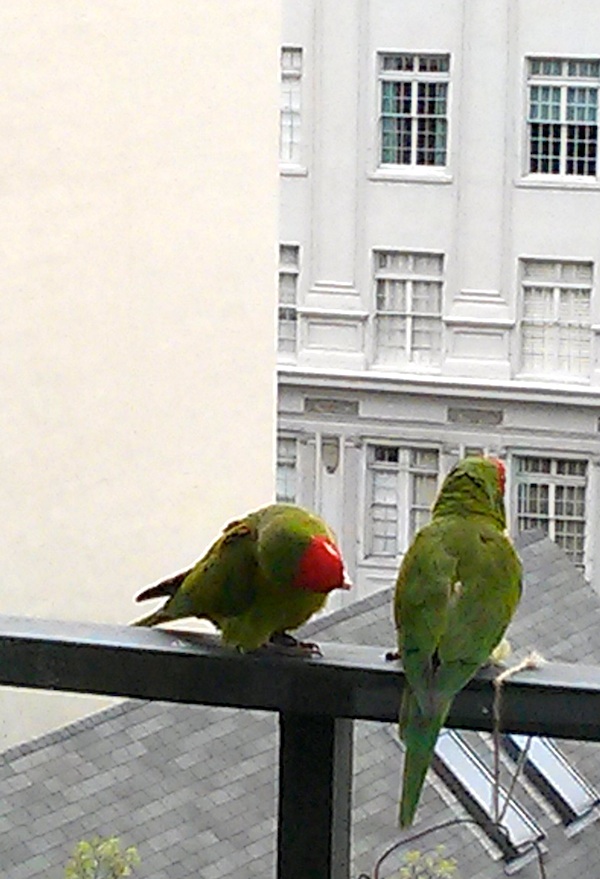 I had heard of these birds, but had never seen them for more than a few seconds as a flash of green coming out of a tree. I took all these pictures from the table with my phone, not wanting to get up and startle them, but they stuck around for some 20 minutes.