In the early 90s, the musician Prince dropped his name and started going by an unpronounceable symbol. He called it “The Love Symbol,” and it’s a combination of the traditional male (♂) and female (♀) symbols.
Apparently (at least according to Wikipedia) Warner Bros had to send out floppy disks with a custom font to the music press they hoped would review his record. As a side note, this would be one of my all-time favorite collectibles. A purple (and you know it’d be purple) floppy disk with the Prince font? So great.
Anyway, so the Prince symbol is not eligible for inclusion in Unicode, which “does not encode personal characters, nor does it encode logos.” Still, though, the Unicode geeks on mailing lists have talked about it, charmingly using the shorthand TAFKAP (for The Artist Formerly Known As Prince). In one 1999 thread, a guy named Marco Cimarosti (personal homepage, in Italian, last updated 2006) proposed a canonical encoding of the glyph, using these combining characters:
01AC LATIN CAPITAL LETTER T WITH HOOK
030A COMBINING RING ABOVE
0335 COMBINING SHORT STROKE OVERLAY
032C COMBINING CARON BELOW
The end result, which will only work if you’re viewing this page in UTF-8 and have proper font support ((If you don’t have the right font, I can recommend Symbola)) is Ƭ̵̬̊. Rendered large, that’s: Ƭ̵̬̊
It’s not perfect, and it isn’t very simple to type, but it beats writing out The Artist Formerly Known As Prince each time.
I never know when the things I’m interested in around copyright policy have general appeal, and I definitely thought this vague joke — on the occasion of the 29th anniversary of the Supreme Court’s decision in Sony v. Universal (the Betamax case) — was a bit obscure.
29 years ago today, the Supreme Court ruled Betamax legal. As the studios predicted, it crushed the budding American film industry forever.
I’ve just completed the wrap-up of the first week of Iron Blogger SF, year two, and man am I excited this time around. By almost every measure, Iron Blogger SF has been a success for me: I’ve written many more posts, been much happier with the way my writing has developed, and as a side benefit have gotten much more traffic than I ever have before. (It’s small numbers, as ever, but the graph is up and to the right, so who can complain.)
In case you don’t know how Iron Blogger works: if you’re participating, you commit to posting a blog post each week. If you succeed, great, and the other Iron Bloggers are a built-in group of readers. If you go a week without posting, you put $5 into a pot, and eventually we use the pot to fund a get-together with some drinks. It’s fun.
After a year, I’m really starting to feel some ownership of the program, and starting to think about ways we can tweak it to better serve our particular group and to help diversify the pool of bloggers. I think everybody is better off if the collection of blog posts each week cover a bunch of different topics from as many different perspectives.
Are you in San Francisco and interesting in joining? It’s been a great way to ease into blogging regularly. Let me know if you’d like to sign up.
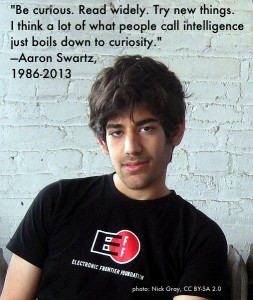
The world is poorer place today without Aaron Swartz, an extraordinary hacker and activist who took his own life on Friday. It’s been a roller coaster of a few days as I and the people I know try to process this news, sadness and anger turning to grief and resolve. There have been many thoughtful tributes to Aaron, who in only 26 years inspired so many with his character and accomplishments: my colleague Peter Eckersley wrote the touching obituary on EFF’s site; Cory Doctorow, Larry Lessig, Quinn Norton, Jillian York, Rainey Reitman, James Grimmelman, Karl Fogel, Brewster Kahle, Rick Perlstein, Danny O’Brien, Tim Berners-Lee, and many more have written beautiful words that do as much as possible to sum up a truly extraordinary life.
It’s a tragedy that he is gone, and another tragedy that we’ve lost the next 50 or so years of Aaron that we might have had. At 26 he had already committed a decade and a half to creating amazing work in the name of causes he supported. Any one of his accomplishments could provide the basis of an impressive obituary. The sheer breadth and depth of them speaks to the scale of his brilliance. That they should all belong to a young man only a year older than I am is incredibly humbling.
One reason I’m so sad today is because Aaron stood so thoroughly for the cause of information freedom. I mean that in two senses: first, of course, he stood up for this endeavor, committing his life to improving the world in this arena. Through his software development, his speaking, his writing, and his life he pushed the ball forward, and we have made progress we would not have made without him. The battle against SOPA, to pick just one example, would have looked very different in his absence.
But also, for so many, he stood for that cause in a more figurative sense. His fight was that fight, and he was to my mind inextricably linked with information freedom. He stood in for it, acting as a representative and an example.
That’s a difficult mantle to bear, and I worry about the stress it would have caused him. I’ve read that he was having difficulty funding his legal defense but was terrified of asking for money, for example. I hope that wasn’t because he knew how much he meant to all of us.
It’s not very productive, though, to try to get into the head of somebody who has decided to take his own life. I understand that his family (and Lessig and many others) think that at least some of the blame rests on the shoulders of an overly aggressive prosecuting attorney. Who can say? I will say this, though. The actions of the prosecuting attorney were completely out of line and disproportionate to any sense of justice. That was as true last week as it is today. Whether or not the ridiculous charges are responsible for his death, they were responsible for destroying his life. That is enough.
It is time to take the energy of anger and of grief and channel it into productive outlets. First and foremost, in tribute to an extraordinary life, should be an effort to rectify the extraordinary injustices he fought. That means copyright reform, improving open access to information, and bringing the penalties for computer crimes into the realm of sanity.
This is a long struggle, and it will mean changing the way people look at the world. I’m saddened to see people still saying Aaron “returned” the files he downloaded from JSTOR. That construction can only underpin the theft metaphor that the prosecution depended on. JSTOR never had anything taken from them. It’s not just nonsensical to say there was something to return, it’s a misconception that contributes to the injustice he faced.
Aaron committed his life to this fight, and if he were still with us he would continue it today. Few people are so brilliant, so talented, and so driven to do what is right as he was. None of us can finish his work, but maybe all of us can.
I took this photograph this morning from Bernal Hill, a little earlier than I would normally be awake because the dog I’m sitting for (Hi, Ace!) demands it. I’ve been up to the hill a bunch of times, and the view is still striking.
I’ve lived in San Francisco for a little over a year now, but I’m still frequently getting asked how I’m enjoying it. It’s a very different city from the last few places I’ve lived. But my most common answer (unless I’m very frustrated with something at the moment) is that it’s so easy here to surround yourself with beautiful scenery.
From this spot on Bernal Hill, you can see from the Candlestick Park and the freeway interchanges all the way across downtown and Bay Bridge to the Golden Gate, way out on the north tip of the peninsula. It’s quite a place, this city.