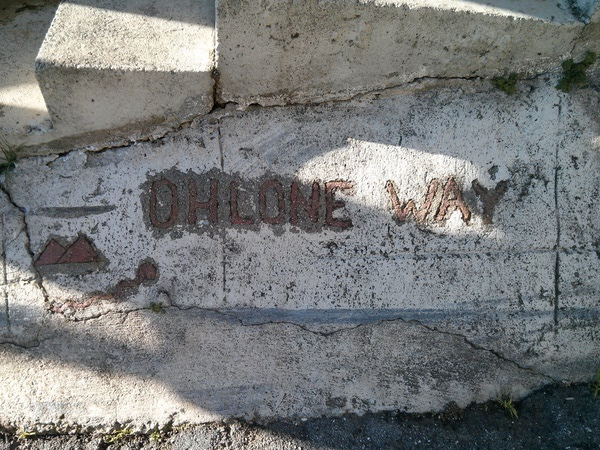
Maira and I were walking around her neighborhood in Glen Park when we stumbled across a tiny road called Ohlone Way. It’s pretty charming. It’s properly marked as a street, but the entire length is unpaved, and not much wider than a single car across. It rained a few days ago, and the ground was still a bit muddy and marked with deep tire tracks.
The name, it turns out, is something of a pun. “Ohlone” is a name used to describe some 40 different groups of Bay Area Native Americans. The groups spoke different languages, had different traditions, and in some cases weren’t even in contact with each other, but have been lumped together because of their geographic proximity. Still, “Ohlone” is preferable to the unwieldy exonym “Costanoans” — derived from the Spanish name for the people — which seems to have fallen out of favor in the 60s or so.
In 1978, an author named Malcolm Margolin published a book documenting the lives of these people who lived in the Bay Area before Europeans arrived, called The Ohlone Way. That book has since become pretty widely cited, and is still in print some 35 years later. FoundSF has published an excerpt from that book that provides a good introduction.
I don’t know how to find more history about this little street in San Francisco, but I’d be surprised to find out it wasn’t named after the book. In any case, it’s worth strolling down Ohlone Way if you find yourself in the neighborhood.
The San Francisco Public Library has the right idea about offering unfiltered Internet access. When you connect to the open wifi network, you’re given this notice and the ability to click right through:
San Francisco Public Library is committed to providing free and equal Internet access to the public without filtering content. We do, however, ask that you respect your fellow library users and refrain from viewing obscene, offensive, harmful matter, or illegal materials prohibited by law.
There may be some uncertainty about what the future of public libraries looks like, but everybody ought to agree that it involves sticking to their core values of free and private access to the information of the world. Asking patrons to be respectful of the other people in the library is a good thing; imposing rigid software-based filters is not.
That’s the right idea even if we assume these are perfect filters that have no false positives and no false negatives. As Cory Doctorow has pointed out in a compelling criticism of UK censorship efforts, that’s never the case, and the collateral damage can be dramatic.
Tetris may be the perfect game, but the beauty of its play is woefully ephemeral. Worse, the lack of a consistent and robust system for recording and annotating individual tetromino drops has, for decades, stunted serious scholarship.
The problem is clear. Now, Tim Hwang and I have proposed a solution. Presenting ((Yes, Tim presented it two weeks ago. I agreed to a press embargo for that duration.)) TETRIS-SYTEM, being a recording method for matches of the puzzle-game.
The notation may feel unfamiliar at first, but even a novice Tetris player will quickly get the hang of it. We hope that one day Tetris scholars, like composers flipping through the sheet music of a symphony, will be able to reconstruct the movements and interplay in their mind’s eyes.
Shuman’s allegations are incorrect. There’s some similarity between the two songs, as I’ll show below, but it does not approach the level of copyright infringement. It should not result in Keys having to license Shuman’s composition or settle with him to use the song.
The complaint is a bit unusual in that it doesn’t really present evidence of copying. It quotes heavily from a blog post about the Keys song, which first noted the similarity. In a later post, the same blogger (Roger Friedman) describes a subsequent interaction with Shuman, by that point lawyered up and looking for some remuneration.
Hearing the similarities
At issue, apparently, is one line in the Alicia Keys song, which she sings about halfway through, and doesn’t repeat. For comparison’s sake, I’ve taken it out of context and placed it next to the similar line from the Holman song:
You can hear the melodic similarity. In technical terms, both songs feature the phrase “lonely girl” sung in a arpeggiated descending minor triad, followed by a second descending major triad (the top three notes of a minor seven chord). But if Keys knows Holman’s song, which seems likely, it’s hard to think of her reference as anything other than a quote.
Quotes, not samples
In Friedman’s blog post, he refers to that as an uncredited “sample.” He does it in kind of a snippy way, too: “Do they teach this sampling stuff at Juilliard?”
Some people think samples are inherently uncreative or unoriginal, and I think those people need to lighten up and listen to some music. But you’d have to be pretty far off the deep end to think that musical quotes are also unacceptable, or that each one requires a license agreement.
Mixing up samples and quotes is especially hazardous in this case. For one thing, sampling of short segments of a song would require getting permission from the owner of the copyright in the sound recording, not the owner of the composition. Shuman’s the songwriter, so he controls the composition, but not Holman’s recording. ((The owner of the sound recording is almost certainly Holman’s record label, ABC Records, which folded into MCA Records, which folded into Geffen. Can you imagine why clearing such a sample might be difficult?))
For another thing, samples are subject to a very strict interpretation of the law. Some people read the landmark Bridgeport v. Dimension case to say that no sampling is allowed at all without a license, no matter how short or insubstantial the sample is. But that’s not the case with musical quotes. In that case you get to do a full fair use analysis of the use, and these allegations wouldn’t stand up against that.
Girls and boys
So we’re talking about one line in a composition that was quoted, not sampled. How much of the original composition did Keys quote, then? Well, it may be useful to go back, here, to the original recording of the song. Before Holman’s smash hit 1970 version, Ruby & the Romantics recorded it in 1963. But the first recording (and the composition) was called “Lonely Boy.” Here’s the relevant section:
This is the original composition, and it’s about a boy not a girl. The song sheet attached to the complaint, too, is for a song titled “Lonely Boy.” That means we’re down to the word “lonely.” (Also, to my ear, the timing is a bit different in this version, with less swing than in either Holman’s or Keys’, but really that’s splitting hairs.) Even assuming that Keys was intentionally and explicitly making an overt reference to Holman’s recording when she sang the “lonely girl” line, it requires an extraordinary stretch to say that reference constitutes an infringement on the original recording.
Alicia Keys quoting even as many as six notes and a word or two from a popular song in a teeny tiny section of her new single just isn’t copyright infringement. I feel for Shuman as a songwriter, but he (and his lawyer) are wrong on this one.
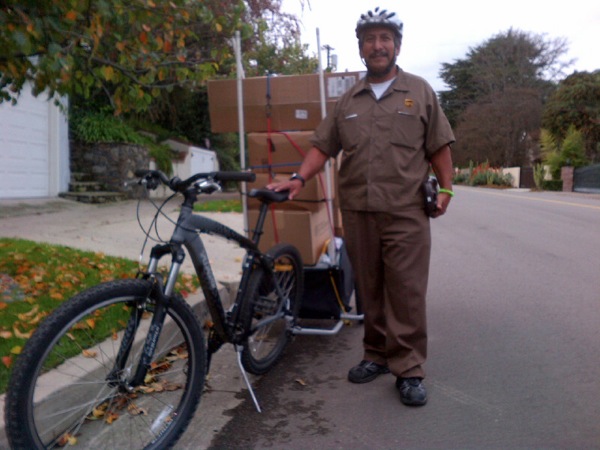
I enjoyed getting this update from my dad about meeting a local UPS bike messenger. During the holiday season, UPS puts some of their drivers on bikes to reduce fuel costs and increase capacity while they’re delivering more packages than during the rest of the year.
Here’s the description my dad sent me in an email this week, and a photo he took of the messenger.
Who knew? UPS has a mini fleet of bicycle delivery guys. This is Umberto, who works Valley Vista Blvd & environs. He loads up from a truck trailer parked on Van Nuys Blvd, and makes several round trips (!) a day. Says he has counterparts “all over LA”. They work from before Thanksgiving to Christmas. He’s riding a stock ‘hybrid’, off-road frame with 21 gears and tires wider than street but thinner than stump jumpers. I’ve seen him climbing the local foothills in low gears for weeks. His trailer is an amalgam of a stock lower section augmented by PVC and bungees – a design “by my manager,” he says, though “we suggested the bungees to hold the load together better.” I had more to ask him, but he was obviously on the clock.