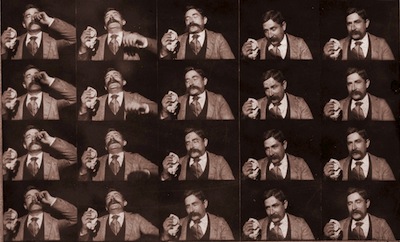
I know this is a wonky thing, but I was reading the Library of Congress blog this week when I saw an article about the centennial of copyright for film works. Prior to that date, film was not on the list of classes of work that were eligible. Filmmakers would instead send in collections of stills from the film, because photographs had already been eligible since 1865, like this series from 1894 of a man named Fred Ott sneezing in an Edison Kinetoscope movie. By the way, I love that this is what movies used to be.
It’s telling — if not surprising — that film studios lobbied at the time for a limit on the statutory damages that could be issued against them for unintentional copying. From the post:
At the urging of the movie industry, the amendment also limited statutory damages that could be awarded against movie studios for innocent infringement of nondramatic works.
How things change. Today’s movie industry, of course, has been one of the largest institutional supporters of insane levels of statutory damages, even filing a brief in support of the RIAA and a $1.92 million fine against a p2p song downloader.
The tragedy, of course, is that the content industry’s addiction to expanding copyright scope has caused it to discard its own history. And that’s our cultural history, too. In William Patry’s latest book, “How to Fix Copyright,” he goes into the sad history of film archiving: Hollywood doesn’t even own copies of many of the films it has produced, and the distended term length has made it difficult to be certain of the legality of preservation efforts by archives and the like. The Library of Congress initially refused to collect samples, because the film was printed on highly flammable nitrate film, but now holds copies of some 200,000 movies. But there is also difficult-to-find and rare footage spread across 1,750 archives.
The failure to archive is real and frustrating. The article refers to one of the first films that was submitted for copyright protection, another of Edison’s films called “The Charge of the Light Brigade.” (Another non-surprise: it’s based on an earlier poem by Alfred, Lord Tennyson, and inspired a 1968 film by the same name.) It was apparently issued as an extra on the Region 2 DVD release of that 1968 film, but I can’t find it online.
Square dongles really truly make processing credit cards not just easier, but possible for all sorts of groups that didn’t have access before: I’ve bought from bands selling merchandise, taxi drivers, food cart operators, and more. I’m worried, though, that Square also makes credit card fraud easier by teaching credit card users security anti-patterns.
In practice, using a Square reader is pretty similar to using any other credit card reader. At the money part of the transaction, you hand your card to the vendor or swipe it yourself through a little dongle hooked up to the headphone jack of an iOS or Android device. Then you enter your email, if you want a receipt sent to you, and sign with your finger on the screen.
That’s the standard description. But it could also be described as handing your credit card to a stranger with a skimmer, and then giving him your signature. That’s what makes it an anti-pattern: it has become commonly used, but is counter-productive to security efforts.
In the overwhelming majority of cases, both parties are honest, and nothing goes wrong. But it’s easy to imagine a few ways it could go wrong. For one thing, if the vendor is dishonest, he could intentionally record the data and use it or sell it later. That’s how a standard skimmer works, and the same problem exists every time you hand your card to the waiter at a restaurant.
Even if both parties are honest though, they are trusting the integrity of the software. I haven’t heard of it yet, but again it’s not too hard to imagine malware that attacks exploits in, say, Android or iOS themselves, and surreptitiously records and sends the card data to the attacker. Such malware could target a wide swath of devices and transactions, and would be more difficult to pinpoint as the source of the data leak.
Unlike the first scenario, this one is exacerbated in the Square era. Previously, malware targeting point-of-sale devices had to be very specialized. Now, though, point-of-sale devices are general purpose computers and vulnerable to commonly known exploits. And in many scenarios, they’re used for other purposes, too, exposing them to more attack vectors.
Really, though, the problem here is not with Square, but with the structure of credit card security. Our card numbers are a secret, and the only information required to carry out many transactions, but we also entrust them with every stranger we make a payment to.
We used to address this issue by an ad hoc security-by-point-of-sale system. If somebody had an official point-of-sale system, our intuition said they were trustworthy, and that was pretty robust. But it’s failing the same way that, say, security-by-letterhead has failed. Technology has made attacks we’ve dismissed as prohibitively difficult much easier, and we need to change our behavior to reflect that.
I was really struck by Maira’s “Sceneries From The Plane Window,” so I decided to shoot my own on my trip back from Portland. Her camera is better than mine, and the conditions in her plane were a bit better suited for photography, but I like the way some of these turned out.
The object in the front of the photograph is the propeller, and my arm (and bright green wrist-band) are a bit too visible in these. Most unfortunately, though, I had to put my camera away for the descent; it’s too bad, because we got an incredible aerial view of San Francisco.
We got that view flying into Oakland from the north, so if you are doing that, I can recommend a window seat on the right hand side.
The talks at day one of the XOXO festival have been incredibly high quality: actual innovators and creators of disruptive media and technology have relayed their experiences of eliminating middlemen and charting new territory for success. It’s just amazing to see what a cool group of people have come together for this event.
One common theme within the talks has been the interaction between innovation, copying, and the effect of copyright and patents. More exciting, these creators have all arrived at a similar mindset and are able to articulate it well.
Innovation depends on copying
There were so many examples of artists and creators talking about the relationship between their own creativity and the influences of others.
Ron Carmen, the developer behind the game World of Goo, talked about how he learned video game development by copying a game he liked. “That’s what you do with things you like. You copy them.” Julia Nunes, the YouTube ukulele superstar, started by doing covers until she was writing original songs.
Bre Pettis, whose company MakerBot makes inexpensive 3D printers, said that their tech development was based on “expired patents, open source code, and epic internal innovation.”
Dan Harmon, the creator of the TV series Community, was explicit about his influences in television and talked about how frustrating it was to work with television executives who didn’t know and breathe its common culture.
Copycats are frustrating, but not worth your time
Many of the talks acknowledged the problem that innovators face costs and risks that uncreative copycats do not, which can cause problems. The guys at Studio Neat showed a slide of a direct ripoff of the Glif, their iPhone kickstand and tripod mount that they funded through Kickstarter. Even the packaging was basically identical. They weren’t happy about it — even the slide was painful to show, they said — but came to the conclusion that their time was better spent innovating than trying to chase down the copycats. “Don’t spend your time chasing down copycats; make them chase you.”
Their story was not unique. Ron Carmen, the game developer, had plenty of experience with ripoffs, including from larger companies. Bre Pettis at MakerBot talked about companies that have taken their open source plans and cut corners to sell cheaper printers. On the other hand, a proliferation of 3D printers, and the corresponding creativity at scale, are good for them as a company. So the difficulty, he said, is releasing their plans in a way that “makes people copy, but encourages innovation.”
Restrictions on copying — especially patents — are “overrated”
“Overrated” was the word the guys at Studio Neat used for patents. Patents aren’t a silver bullet or a magical force field against copying, and spending time in court is worse than spending time innovating. In their field, which moves fast, the first mover advantage is more important than a legal monopoly.
MakerBot’s Bre Pettis said that he always assumed the patent system would collapse before his company was big enough to have to deal with it, but now we’re “stuck with it.” His company makes printers that are between $1,000 and $2,000, but compete with $200,000 models. The companies that make those have patents that they are eager to enforce, making innovation in that space difficult.
The best way to be in the right place at the right time is to be in all the places all the time
Almost all of the speakers described a moment where their works “tipped,” and suddenly became much more popular. The ukulele player Julia Nunes had one of the best descriptions about how it doesn’t come in the form of “a big break,” but rather as many small leaps and opportunities, from being featured on the front page of YouTube to getting to open for Ben Folds to appearing on Conan O’Brien.
The other speakers had similar “breaks”: for Studio Neat it was John Gruber posting a link to their project on his website; for the creators of Indie Game: the Movie, it was Andy Baio tweeting about them. What these breaks have in common is that they were unforeseen, and the result of a piece of content making it into the right person’s hands at just the right moment.
So how do you facilitate that? None of the speakers said it directly ((Julia Nunes came closest when she said “I make myself incredibly easy to find.”)) but the surest way to be in the right place at the right time is to be all the places all the time. This is hard for people to do, but it’s easy for content: just make it easy to copy and distribute your work, and your fans will take care of the rest.
Cory Doctorow refers to this strategy as “thinking like a dandelion.” Instead of fretting and focusing on each copy, make as many as you can and make it easy for others to make them too.
***
One of the remarkable things about this conference has been the invigorating effect it has on my creativity. Seeing these people talk about making things — I want to make things! Thinking like a dandelion, and getting my creativity out there, seems like a great way to start.
The influential federal judge Richard Posner turned some heads recently with a long review of Justice Antonin Scalia’s new book Reading Law. In the critique, which serves as more of a general indictment of Scalia’s school of textual originalism, Posner digs in with some strong words. The whole thing has kicked off a back-and-forth worth reading. But why should I care about a verbal judgefight — even one that pits the great Posner against Scalia?
The answer, as is so often the case, lies at the nexus of burritos and sandwiches. Unsurprisingly, Posner and Scalia have differing opinions on the 2006 landmark burrito law case White City Shopping Center, LP v. PR Restaurants, LLC — more hilariously styled Panera v. Qdoba — in which a Massachusetts judge held that a burrito is not a sandwich. Panera, whose lease agreement with the White City Shopping Center prohibited the mall from renting to another sandwich vendor, could not prevent Qdoba from moving in and selling burritos.
Scalia applauds the decision; Posner is more skeptical. In particular, he doesn’t think the dictionary definition of sandwich used in the case (“two thin pieces of bread, usually buttered, with a thin layer (as of meat, cheese, or savory mixture) spread between them”) goes far enough. Judge Posner:
A sandwich does not have to have two slices of bread; it can have more than two (a club sandwich) and it can have just one (an open-faced sandwich). The slices of bread do not have to be thin, and the layer between them does not have to be thin either. The slices do not have to be slices of bread: a hamburger is regarded as a sandwich, and also a hot dog—and some people regard tacos and burritos as sandwiches, and a quesadilla is even more sandwich-like.
Posner does not go so far as to suggest that a burrito is a sandwich, just that the judge and Scalia arrive at the correct conclusion for the wrong reason.
The dictionary definition is corroborated by other governmental institutions. The USDA’s Food Standards and Labeling Policy Book [pdf], for example, gives a guideline for how a burrito may be labeled:
A Mexican style sandwich-like product consisting of a flour tortilla, various fillings, and at least 15 percent meat or 10 percent cooked poultry meat. The flour tortilla is rolled and may or may not have tucked ends.
To my mind, burritos, falafel, wraps, and similar products fall into a category sometimes dubbed the Urban Food Log. Are UFLs a proper subset of sandwiches? On what grounds could a reasonable person justify such a distinction?
One of the all-time classic burrito v. sandwich essays, Good Magazine‘s Is a Burrito a Sandwich? offers an answer. We decide the classification with a gut take, and that intuition is informed by cultural factors. Good says:
No unifying theory exists to classify your meal by appearance, ingredient, or construction method. The sandwich is a social compact between lunchers: We have come to a consensus on a group of foods that we will call “sandwiches,” one that defies even the most obvious attempts at classification. … That degree of universal cultural acceptance doesn’t happen overnight. The burrito has a long time to wait.
Diving deep into the notion that a burrito is not a sandwich for cultural reasons, the excellent and very readable Michigan Journal of Race and Law article incredibly titled “Is a Burrito a Sandwich? Exploring Race, Class and Culture in Contracts” makes some compelling points about Panera v. Qdoba and its unstated racial undertones. Its author, Marjorie Florestal, presages Posner’s concerns about reliance on dictionary definitions, and goes further to question the supplemental materials a court might use to distinguish the two. Expert witness testimony, like that offered by Chef Christopher Schlessinger, may seem to offer direction (“I know of no chef or culinary historian who would call a burrito a sandwich. Indeed, the notion would be absurd to any credible chef or culinary historian.”) but raises more questions.
Florestal asserts that — to the extent possible — burritos have a race, and that race is Mexican. Sandwiches are white. That meant, according to Florestal, that “race played a significant but silent role in the proceedings.”
As an amateur burrito historian, I can’t help but find myself fascinated with these questions. Is a burrito a sandwich? We know what the judges say. But to extent that these definitions are built on developing cultural understanding, it’s safe to say the jury is still out.