I’ve been following the discussion about Creative Commons BY-NC-SA v4.0d1. This release is an important one for many reasons; one is the sense that v4.0 is expected to remain in place even longer than the 5+ years v3.0 has been final.
One interesting question concerns source requirements in CC licenses, and particularly in ShareAlike licenses. Should freely licensed culture, like free software, come with some sort of “source”? What form does that even take for cultural works? In some software licenses, such as the GPL and Apache license the source code is defined as the “preferred form for making modifications.” By that definition, some sort of source requirement could seem workable for culture. But in practice, the preferred form for modification just varies too much in cultural works based on the sort of modification. That leads to a problem that Christopher Allan Webber has summed up neatly:
as far as I can tell it’s simply too hard to draft legalcode that’s not incredibly hard to comply with for many cases of users, or which ends up being so vague that it ends up being basically useless or completely ignored.
A second question I’ve been following is whether there should be no-DRM clauses in the licenses. At first glance it seems similar to the source requirement argument, in that technically speaking both “object content” (i.e., content presented in a form other than the “source” preferred for modification) and DRM-wrapped content are difficult but not impossible to work with. There’s one major difference between the two, though: anti-circumvention laws in place make DRM breaking illegal in a way that modifying object content isn’t. In effect, that makes the DRM an overriding all-rights-reserved for anybody who wishes to use it as such. As Rob Myersdescribes the difference:
unlike with DRM one cannot have people fined or imprisoned if they decide they are going to do the work of translating the work to a more useful format. Low-fidelity or non-machine-readable media are a separate issue from legal restrictions. In the absence of copyright or DRM I can scan a hardback book or rip a vinyl record, neither of which are high-fidelity, digital, or read/write media.
Finally, one of the more out-there suggestions that’s sparked a lot of discussion is a proposed re-branding of the NonCommercial license as Commercial Rights Reserved. Changing the name of a license clause seems like a big deal to me, because the different modules are a major part of the CC brand and the way that many people understand them. But I think this proposal is so much closer to the meaning of the license it must be seriously considered. On the mailing list, one participant has objected to this proposal on the grounds that she uses NC licenses to indicate that “a work is meant to be primarily or entirely outside of the commercial realm rather than the creator reserving commercial rights.” I think that she’s unwittingly highlighted the problem: people are attracted to the words “NonCommercial” without a real understanding of what the license text says. The results are not good for anybody, because the works then carry less freedom and aren’t subject to the same conditions the licensor thinks they are.
It’s not the usual way I think of it, but each of the CC modules is about reserving some rights. BY reserves the right to publish a work without attribution, SA reserves the right to choose a license for a work, ND reserves the right to make derivatives. It only stands to reason that NC reserves the commercial rights, but I don’t think that’s how the clause is generally understood.
I’ve really been enjoying these conversations, and I appreciate that CC gives the public an opportunity to engage at this level. I’m looking forward to seeing how this drafting process develops.
I spent some time this weekend reading the Reynoso Task Force Report [pdf], the findings from a group of UC Davis professors, students and administrators, which assigns responsibility for the November 18 pepper spraying incident and delivers recommendations to the administration.
I highly recommend reading the report. It is extremely readable and direct, and provides unusually straightforward insights about leadership failures and dysfunctions. The task force report is about 30 pages, and additionally incorporates by reference the 150-odd-page Kroll report, which provides much more detail about facts, the timeline of events, and best practices in policing.
The Task Force, which was led by former California Supreme Court Associate Justice Cruz Reynoso, pulls no punches. “The pepper spraying incident that took place on November 18, 2011 should and could have been prevented.” Reading the report, I felt that the failings that led to the pepper spraying fall into three categories. These problems are common, and while the results are rarely as disastrous as the casually-pepper-spraying cop, they are worth identifying and addressing before the situation goes off the rails.
First, the entire situation escalated because of poor risk assessment, driven by a disconnect between perceived risk and actual risk. In particular, campus administrators were exaggerating the risks that appear in the media: in this case, the crime and sanitation issues associated with Occupy protests in nearby Berkeley and Oakland.
[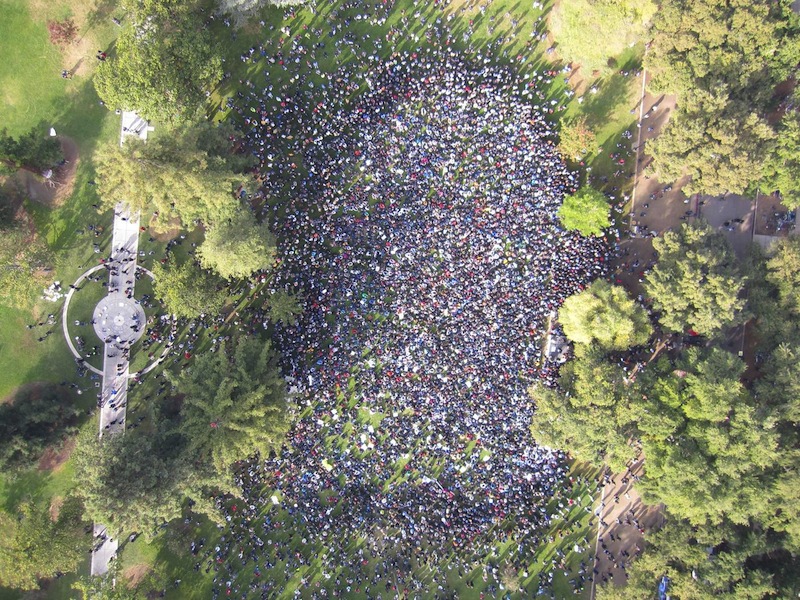](http://publiclaboratory.org/notes/micheletobias/11-21-2011/occupy-uc-davis-nov-21-2011)UC Davis protest after the pepper spraying, taken from a helium balloon / Photo from Public Laboratory / CC BY-SA 3.0
Leading up to the police raid, administrators behaved as if they were certain that the Davis protest was filled with “non-affiliates” (protestors who weren’t students) — even though they hadn’t received any data to suggest so. The report’s Introduction even refers to a New York Times article about health and safety issues at Occupy protests on college campuses that administrators e-mailed to Police Chief Anette Spicuzza.
But their colleague Assistant Vice Chancellor Griselda Castro had actually been to the protest, and had reported that there were few if any participants that weren’t students. Section III-C describes Castro “detailing her conversations with protestors, counseling caution on the part of the Leadership Team, and advocating against the removal of the tents…. AVC Castro’s statement was met with silence.”
The risk of sensational crime against students from participating non-affiliates was then at least unknown and likely very small. When the risk is exaggerated, though, it seemed preferable to take extreme actions rather than the “almost self-evident” solutions proposed in the report’s Section I-B — solutions like posting police to provide security and monitoring to the encampment over night. Such measures would’ve given the administration an opportunity to do a real evaluation of the risks.
Second, the police actions were magnified by the background of police militarization across the country and in the UC system in particular. The past decade has seen a shift to the Miami model for police departments, even where that sort of approach is completely inappropriate. Section I-C reports that Chief Spicuzza “attempted, unsuccessfully, to dissuade her officers from using batons and pepper spray or to prevent them from wearing ‘riot gear’ during the operation.”
Why would the the UC Davis Police Department wear riot gear to enforce a camping ordinance? Why does the UCDPD even have riot gear? It can be traced right back to rampant militarization of police departments against all common sense. The report rightly recommends (in Section IV-B) that the UCDPD should review the ratio of “sworn officers (authorized to carry weapons) to other personnel.”
That aggressive arming of the police force is just compounded by the department’s incompetence. Not only is there a serious discipline problem — Section II-B is simply titled “There is a Breakdown of Leadership in the UCDPD”, for example — but the pepper spraying operation was carried out with major tactical blunders. The Kroll report explains: “The actual crowd control formations used by the UC Davis Police did not comport to contemporary policing practices,” including the use of the inverse wedge as a skirmish line. Other major components of the November 18 raid were similarly bungled, like the fact that the police made no plans for transporting prisoners.
Most troubling are the areas in which the police have actively departed from the law. Section I-E notes that there was confusion as to the legal basis for the raid in the first place, and points out that without clear knowledge of the relevant policies or laws among the administrators and police, there could be no understanding among the protesters:
Protesters have a right to be told what laws they are alleged to be breaking. When there is ambiguity as to whether or not the police action is lawful or not [sic], it is foreseeable that there will be an increased likelihood that protestors will resist police demands.
Section II-D explains that the pepper spray used by Lt. John Pike (the MK-9) was not an authorized weapon for the department, and the “the investigation found no evidence that any UCDPD officer had been trained in the use of” it.
Four years before the pepper spraying, Lt. Pike had subdued a deranged patient threatening his colleagues, opting against the use of a weapon in the close quarters of a hospital room. His quote at the time was: “You’ve got all these tools on your belt, but sometimes they’re not the best tools.” He was right then, but in fact, sometimes it’s best not to even have those tools on the belt.
Finally, nearly every communication point was plagued with uncertainty about who had authority to issue orders and which conversations were to be interpreted as “commands” vs. “suggestions”. The most marked example of this dynamic was the selection of 3pm on a Friday as the correct time for a raid. Chief Spicuzza had concerns about the Leadership Team’s suggestion for a daytime raid, but didn’t voice them because she thought she was receiving orders. Section I-D:
The above example is illuminating in that it showcases a process where a major incident objective was determined in an ad hoc setting and where the principal decision maker, Chancellor Katehi, did not realize her statement was both viewed as an “executive order” and a “tactical decision.”
These sorts of communication breakdowns are excruciating to read about, especially given the systems that are in place to bypass them. The lesson from this point is plain: communication issues only get solved with more communication.
The Reynoso Report provides a rare candid evaluation of these points of systemic breakdown, and gives smart suggestions on how to address them in the future. I hope the UC Davis administration is willing to hear it.
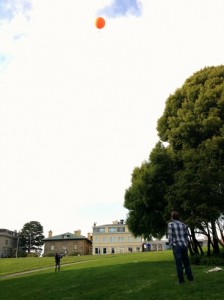Trevor and I launching the balloon. Photo by Maira Sutton.
Last weekend, Trevor and Maira and I took the balloon mapping kit I received as a reward for backing the Public Laboratory Kickstarter project out for a spin. The kit is simple and inexpensive by design. It contains a 5.5 foot balloon, a very long string and winder, rubber bands, and assorted clips, rings and carabiners. You provide a camera, a soda bottle camera rig, and helium.
Public Laboratory has made the kits for “grassroots mapping”, but for this trip up I was just interested in getting some photographs from the air and seeing how that goes.
We chose to fly at Alta Plaza Park in Pacific Heights, because it was close to where the helium tank rental was, and the tank was about 40 lbs. Set-up was easy: Public Laboratory provides really good directions in the kit, and up-to-date video supplements online. The soda-bottle camera rig was a bit more complex than I had thought going into it, but Maira was a champ about putting it together.
Of the 600 photos or so we took, we got a handful of interesting ones. That may seem like a low yield, but I think it’s not bad for a first round. Here are some of my favorites:
To get a sense for the whole collection, I put together a video that speeds up the photos, taken about a second apart, to 6fps. ((I used the program mencoder to make this video. The command I used is listed in the video description on YouTube, should it be helpful.)) The audio is from the public domain recording of the Hungarian Rag played by Pietro Deiro, found on the Public Domain Review.
I underestimated the complexity of grappling with the camera and the balloon in the moments before flying. For one thing it was just a bit too windy to be flying a balloon, but for another, we ran into an annoying technical bug. The camera I use, a Canon Powershot SD 870, has the necessary “continuous” mode, but defaults to single-shot mode each time it gets powered on.
[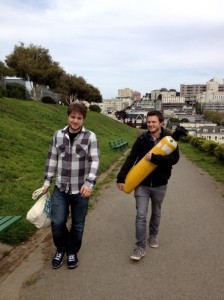](https://parkerhiggins.net/wp-content/uploads/2012/04/helium.jpg)Carrying the helium, pre-launch. Photo by Maira Sutton.
That meant futzing with the controls once the camera was already on and in the harness, and trying to avoid any buttons. I think the photos we got are washed out because I knocked one of the settings off of automatic, but I couldn’t hunt down which.
Fortunately, each of these problems are solvable. Picking a calmer day, a clearer ground, and a heavier payload should help with the first. ((On a windy day, I could also take a kite out instead of a balloon, something I’m definitely looking into.)) For the second, I’ve installed a firmware extension on my camera called CHDK, or the Canon Hacker’s Development Kit, which allows for finer-grained control of camera settings. Before the next flight, I’ll be looking into the best configuration.
It’s no surprise that the major traditional publishers are afraid of e-books. Like record labels and movie studios before them, publishers have seen the spectre of disruptive technology on the horizon and have dug in their heels. Where they’ve accepted e-books they’ve done so half-heartedly, neutralizing the benefits of the new medium with opaque DRM schemes that emulate the limitations of print books as closely as possible. As Clay Shirky puts it:
The original promise of the e-book was not a promise to the reader, it was a promise to the publisher: “We will design something that appears on a screen, but it will be as inconvenient as if it were a physical object.”
How could inconvenience be a selling point to a publisher? It’s because they fear bundle failure. Publishers have always been able to bundle the text of a book (the “content”) with a physical volume (the “container”). When that’s the case, selling books is almost like selling any other physical object, with infrastructure in place for designing, manufacturing, distributing, and selling at retail. Convenient e-books threaten to unsettle that arrangement — they make attractive the idea of consuming just the publisher’s content, and not its container.
The unanswered question that is driving publisher e-book strategy is about the perceived value breakdown of that bundle. How much have people been paying for just the content, and how much were they paying for the nice container? When publishers talk about the need to avoid “devaluing” books with low e-book prices, they’re talking about this question.
One shortsighted answer presumes that the value of an e-book is the value of a hardcover minus the perceived cost of printing. This premise, in fact, informs the e-book pricing strategy of most publishers. But it’s both incorrect and dangerous. It leads to the strategic error of situating e-books as substitute goods, instead of complementary goods, for a publisher’s other offerings.
When there’s a substitute good for something you sell, you’ve got to either work against it or make it as profitable as the good it’s displacing. DRM comes from an effort to do both. It diminishes the advantages of e-books over their printed counterparts and strives to limit their distribution to full-price retail sales. ((Going, of course, one step further than printed books. Publishers haven’t historically been able to control secondary sales or sharing.))
If instead publishers recognized the text as a complementary good, they’d be in the much more comfortable position of trying to increase the demand for it. After all, the actual publication and distribution of volumes is already just one step on the end of a long workflow, each step of which is supposed to make the text better and increase demand. It’s crazy to subvert that whole chain to preserve the last link, just because it’s the one at which the actual revenue comes in.
So what are the goods and services for which the text of a book can be a complement? That’s where publishers earn their paycheck. It could be events with authors, merchandise, film rights, beautiful print editions — the point is that it is easier to monetize a popular book than an obscure one, even if you’re not making most of the profits on sales of the book.
I wrote much of the April Fool’s Day edition of EFF’s EFFector newsletter, which we sent out to our subscribers yesterday. (Some of the stories there were submitted by my colleagues, and the brilliant lead story in particular is nearly entirely Maira‘s creation.) As far as I can recall, it’s the first intentionally funny writing I’ve done since Buckley’s Student Voice backpage in 2005-2006.
The reactions online were pretty good, and I’m proud of some of the jokes. I’m also not proud of some of them, but there they all are, one way or another.